
Finding affordable vacation ideas for blended families requires solving a problem that most travel content has never seriously attempted to address. You are not just planning a vacation. You are managing different ages, different personalities, potentially different custody schedules, different relationships between children who may still be figuring out how to exist in the same household, and a budget that has to cover more people than a traditional family vacation while working with finances that blended family life has almost certainly complicated. I have been part of a blended family for six years and have planned four family vacations that had to work for two adults, three children from two different previous relationships, and a budget that required genuine creativity. Here is what I actually learned.
1. Start With One Honest Family Meeting Before You Book Anything
The most expensive mistake blended family vacations make has nothing to do with destination choice or booking timing. It is skipping the conversation where every person in the family, including the children old enough to have genuine opinions, has a real say in what the trip looks like. Blended family dynamics mean that children may already feel like decisions are made for them rather than with them. A vacation that lands on top of that dynamic without consultation is a recipe for resentment that no beautiful beach resolves.
Hold one family meeting before any booking happens. Let each person name one thing they genuinely want from the trip, not a specific destination but an experience type. Adventure, beach time, trying new food, seeing wildlife, having time to read by a pool. Collect these inputs and look for a destination that naturally accommodates multiple items on the list simultaneously. National parks do this better than almost any other destination type because they offer hiking for the active kids, wildlife for the curious ones, campfire time for the relationship-building moments, and enough varied terrain that people with different energy levels can separate and reconnect throughout the day without anyone feeling excluded or forced. Starting with this conversation changes the emotional architecture of the entire trip.
2. National Parks Road Trips
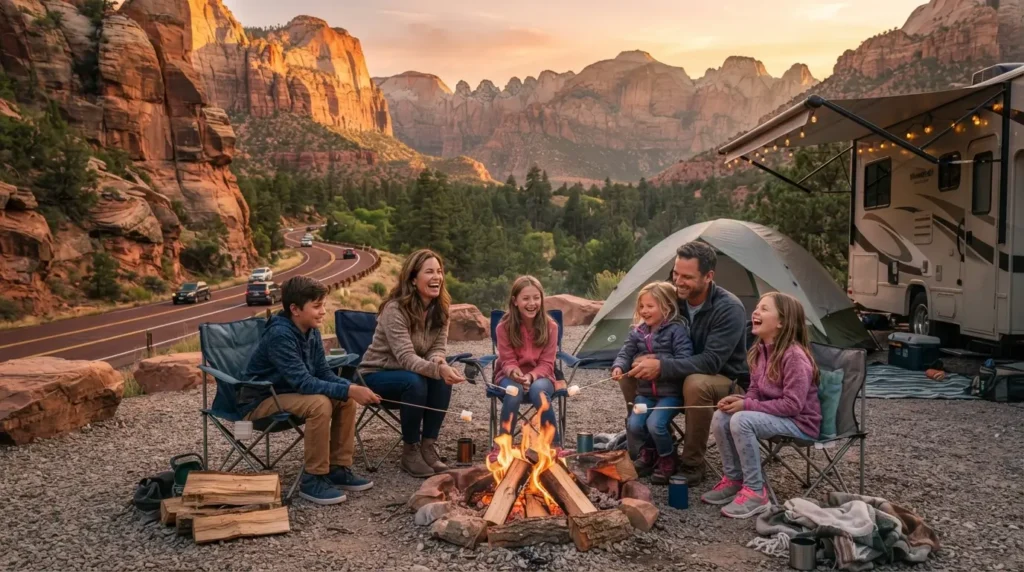
A national park road trip is the single best affordable vacation format for blended families, and the reasons stack so comprehensively that it is worth explaining each one rather than just asserting it. The America the Beautiful Annual Pass at $80 covers entry to every national park and federal recreational land for a full year for an entire vehicle of passengers. For a blended family of five or six, that is eight to ten dollars per person for a year of national park access. The per-visit cost comparison to theme parks, resorts, or international travel is almost absurdly favorable.
The road trip format specifically suits blended families because the shared experience of driving through extraordinary landscapes creates neutral emotional territory. Nobody in the car has a history with the Badlands. Nobody has strong feelings about who belongs at Arches National Park. The landscape creates a shared reference point that doesn’t carry any of the complicated history that home environments carry for blended families. Campground fees run $15 to $30 a night for a site that accommodates an entire family. Cooking at the campsite cuts food costs dramatically. KOA Holiday campgrounds offer cabins that sleep six to eight at $70 to $120 a night for families who want the camping experience without the gear investment. The American Southwest circuit through Zion, Bryce Canyon, Arches, and the Grand Canyon covers enough visual variety to fill ten days without a single repeated landscape.
3. All-Inclusive Resorts With Strong Kids Programming
All-inclusive resorts sound like the expensive option and are frequently the most cost-effective option for blended families when the full math is calculated honestly. Every meal, every drink, every snack, most activities, and structured childcare all included in one upfront price removes the constant financial decision-making that wears parents down on regular vacations and allows children to participate in activities without every request generating a conversation about whether the budget covers it.
Beaches Resorts in Turks and Caicos and Jamaica are specifically designed for families with children across a wide age range. Kids clubs operate from early morning to late evening with activities grouped by age, which solves the blended family challenge of entertaining children who may be four, nine, and fourteen simultaneously. The youngest children have supervised play. The middle children have organized activities. The teenagers have their own space with appropriate programming. The adults have actual time together that doesn’t involve managing three different children’s needs simultaneously. Club Med Cancun Yucatan operates on the same model at prices that are more accessible than Caribbean resort alternatives. Moon Palace Jamaica includes water park access, multiple restaurant options, and evening entertainment in its all-inclusive rate, which at $150 to $200 per person per day for a family of five works out to $750 to $1,000 a day total that covers everything including food and activities.
4. Beach Towns That Aren’t Famous
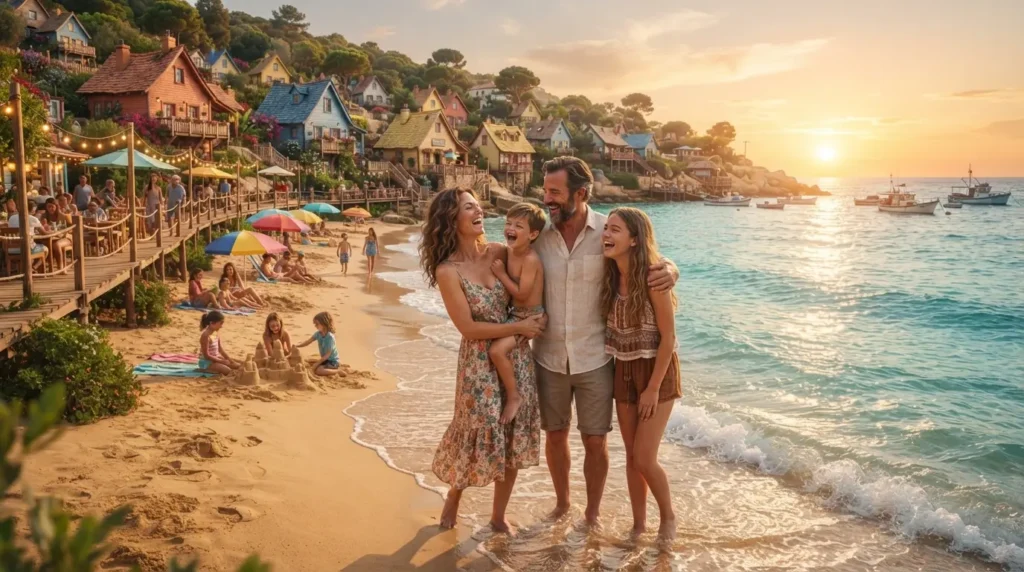
Famous beach destinations charge famous beach prices for the privilege of sharing them with everyone else who chose the same obvious option. For blended families working with real budgets, the non-famous beach town thirty to sixty minutes from the famous one delivers the same ocean, the same sand, and frequently better restaurants at a fraction of the cost with a fraction of the crowds.
Cape Charles, Virginia on the Chesapeake Bay is a small historic town with a beautiful beach, a main street of independent restaurants and shops, and accommodation options that run $100 to $150 a night for houses large enough to sleep a blended family comfortably. Apalachicola, Florida on the Gulf Coast has some of the best seafood in the country, a charming downtown, and beach access at prices that make the more famous Florida destinations look unreasonable. Cannon Beach, Oregon gives you Pacific Coast drama with Haystack Rock, tidepools that entertain children of all ages, and a town with enough galleries, bookshops, and restaurants to fill rainy days. For blended families willing to consider international options, Puerto Morelos, Mexico sits fifteen minutes from Cancun’s airport with a protected reef offshore, a town square that feels authentically local, and accommodation that runs $80 to $120 a night for vacation rentals large enough for a blended family.
5. Vacation Rentals Over Hotels Every Time
This is the accommodation decision that most consistently determines whether a blended family vacation is manageable or miserable. Hotel rooms are designed for two adults and maybe two children in a space that, for a blended family of five or six, creates a compression of bodies, belongings, competing bedtimes, and conflicting morning schedules that generates friction before anyone has left the building.
A vacation rental with multiple bedrooms, a living room, a kitchen, and a backyard or outdoor space changes every dynamic. Children from different households can have separate sleeping spaces, which matters more than parents sometimes realize for kids who are still establishing comfort with their new family configuration. Adults can have a private space that isn’t the bathroom. Morning routines that involve seven people sharing one bathroom are replaced by two bathrooms and a kitchen where breakfast happens at whatever time each person naturally wakes up. Vrbo and Airbnb both have excellent family-appropriate vacation rental inventory with filters for bedroom count, bathroom count, and amenities like pools and outdoor spaces. Weekly rates on vacation rentals run 25 to 35 percent less than the equivalent nightly rate multiplied out, which for a blended family staying a full week represents meaningful savings. A four-bedroom vacation rental at $200 a night split across six people costs $33 per person, which beats hotel room pricing decisively.
6. Washington DC
Washington DC is the most underrated affordable vacation destination for blended families in the United States and it is not particularly close. The Smithsonian Institution’s nineteen museums are all free. Every single one. The National Zoo is free. The National Mall connecting all of these institutions is free. A blended family of six can spend five full days in Washington DC visiting world-class museums, monuments, and cultural institutions and spend zero dollars on entrance fees. The budget goes entirely to accommodation, food, and transport, which are all manageable at $120 to $160 a night for a vacation rental in a family-friendly neighborhood like Capitol Hill or Dupont Circle.
The content range of Washington DC’s free attractions specifically suits the age diversity of blended families. The National Air and Space Museum entertains children of every age simultaneously. The National Museum of Natural History has the Hope Diamond for the aesthetically inclined children, dinosaur fossils for the science kids, and live butterfly exhibits for everyone. The National Museum of African American History and Culture provides genuinely important historical content that starts conversations worth having as a blended family moving through the world together. The Lincoln Memorial and Jefferson Memorial at night, accessible by rideshare from any neighborhood, cost nothing and look extraordinary. Few destinations deliver this quality and quantity of educational, engaging content at this price.

7. Florida’s State Parks Over Theme Parks
Florida theme parks are the default family vacation choice for a significant portion of American families and one of the most financially punishing choices a blended family on a real budget can make. A single day at Walt Disney World for a family of six costs $700 to $900 in tickets alone before food, merchandise, parking, or accommodation. Florida’s state park system offers a completely different calculation.
Ichetucknee Springs State Park near Gainesville has tubing on crystal-clear spring-fed rivers that costs $6 per person. Wakulla Springs State Park has glass-bottom boat tours, swimming in one of the largest and deepest freshwater springs in the world, and wildlife that includes manatees and alligators, for $6 per person. Fort De Soto Park near St. Petersburg has been rated one of the best beaches in the United States, with calm, shallow Gulf water that is safe for young children, fishing piers, kayak rentals, and campgrounds. Silver Springs State Park has glass-bottom kayaks and spring snorkeling at prices that a blended family of six can access for under $100 total for a full day. The Florida State Parks Annual Pass costs $120 and covers entrance to all 175 state parks for a year, which for a blended family taking even two Florida trips pays for itself immediately.
8. A Cruise
Cruises occupy a specific position in blended family vacation planning that makes them more valuable than their reputation as a luxury option suggests. The cruise model, one upfront payment that covers accommodation, most meals, entertainment, and transport between destinations, eliminates the constant negotiation over what activities to do and what they cost that creates friction in blended family vacations where different children have different financial expectations from their different previous family contexts.
Carnival Cruise Line and Norwegian Cruise Line both offer family-accessible rates that bring per-person daily costs to $80 to $120 all-inclusive for interior cabin bookings made well in advance. For a blended family of six, two connecting interior cabins on a seven-night cruise cost $3,360 to $5,040 total, which when divided by seven days and six people represents $80 to $120 per person per day including accommodation, all meals, entertainment, and transport to multiple destinations. Kids clubs on major cruise lines operate across broad age ranges, which solves the blended family challenge of children with significantly different ages and interests needing simultaneous engagement. Disney Cruise Line is the premium option with the highest quality kids programming but also the highest pricing. Royal Caribbean’s waterslide parks, rock climbing walls, and FlowRider surf simulators specifically suit blended families with older children and teenagers.
9. Camping With the Right Setup
Camping is the vacation format that blended families consistently undervalue because they associate it with roughing it in ways that seem impractical for a large group of people with different ages and different comfort levels. The camping that works for blended families is not minimalist wilderness camping. It is comfortable, well-equipped camping at established campgrounds with bathroom facilities, electrical hookups, and enough space that the family can spread out rather than being compressed into hotel room proximity.
KOA Holiday campgrounds operate across North America with cabin options that sleep six to eight at $70 to $120 a night, which beats comparable accommodation options for large groups dramatically. Standard tent sites with electrical hookups run $35 to $50 a night at KOA properties and typically come with access to swimming pools, playgrounds, and camp store amenities. The campfire dynamic specifically benefits blended families because it creates an unstructured, low-pressure social environment where conversation happens naturally without anyone being required to perform enthusiasm or engagement. S’mores, ghost stories, and the particular quiet of a campground at night create shared memories that belong to the new family unit rather than carrying history from previous configurations. Hipcamp and Tentrr surface private land camping options that are sometimes more beautiful and more private than established campgrounds at comparable or lower prices.
10. A Learning-Focused Trip to a Historic City
Historic cities with strong educational tourism infrastructure offer blended families the specific benefit of shared discovery. Nobody in the family has a personal history with the French Quarter in New Orleans, the Revolutionary War sites in Philadelphia, or the civil rights landmarks in Birmingham, Alabama. Visiting these places together creates genuinely new shared knowledge and shared emotional experience that belongs to the blended family as a unit, which is a quiet but real contribution to the ongoing project of building a family identity that is its own rather than a combination of two previous ones.
Philadelphia is one of the best affordable blended family destinations in the United States for exactly these reasons. The Independence Hall, Liberty Bell, and National Constitution Center are all accessible by walking from the same neighborhood. The Philadelphia Museum of Art (famous for the Rocky steps) is genuinely excellent and free on the first Sunday of each month. Reading Terminal Market is one of the great American food markets where blended families with diverse food preferences can each find something they actually want to eat without a negotiation. New Orleans adds food culture, jazz history, and the extraordinary sensory experience of the French Quarter that children of every age respond to with genuine curiosity. Both cities have Airbnb and Vrbo vacation rental inventory in walkable neighborhoods at $150 to $200 a night for properties large enough to sleep a blended family comfortably.
Budgeting Strategies Specific to Blended Family Travel
Blended family travel budgets have specific pressures that require specific strategies rather than scaled-up versions of couple or small family budgeting.
Calculate Per-Person Daily Costs Before Comparing Destinations
The sticker price of a destination or accommodation type is meaningless without dividing by the number of people traveling and the number of days. A vacation rental that costs $250 a night sounds expensive until you divide it by six people and arrive at $42 per person per night. A hotel that costs $120 a night sounds reasonable until you realize you need two of them for a blended family of six, making the actual cost $240. Always calculate per-person daily costs when comparing options, because the relative value of different approaches only becomes visible at that level of specificity.
Address the Financial Equity Question Directly
Blended families sometimes include children from households with different financial situations, which can create visible inequity on vacation if some children have spending money for souvenirs, activities, and treats while others don’t. Addressing this directly before the trip, by establishing a standard per-child spending allowance that comes from the family vacation budget regardless of each child’s household income, removes the potential for financial visibility to generate resentment or embarrassment. The amount doesn’t need to be large. A $30 to $50 per-child souvenir allowance communicated and distributed equally eliminates the problem entirely.
Book Early for the Best Prices on Large Accommodations
Vacation rentals and cruise cabins for large groups book out significantly earlier than equivalent options for smaller parties because the inventory of truly large, well-reviewed family properties is genuinely limited in most destinations. For blended families of five to eight people, starting accommodation research four to six months before travel dates rather than the six to eight weeks that works for smaller groups is the difference between finding an excellent property at a reasonable price and choosing between inferior options at elevated last-minute rates.
Frequently Asked Questions
What are the best affordable vacation ideas for blended families with very different children’s ages?
National parks, cruises, and all-inclusive resorts with kids club programming all accommodate wide age ranges simultaneously. National parks offer activities from gentle nature walks for young children to serious hiking for teenagers without anyone feeling excluded. Cruises and all-inclusive resorts use age-grouped programming that lets each child engage at their appropriate level while parents have adult time. Washington DC’s free museum network covers ages four through seventeen with genuinely different attractions for different developmental stages.
How do blended families handle custody schedule constraints when planning travel?
Book travel during custody windows you already control rather than trying to negotiate additional time specifically for a vacation, which often creates conflict that poisons the trip before it starts. Identify the longest continuous window you have with all children present and build the vacation within that window. Shorter, more local trips that fit within regular custody schedules are more accessible and less logistically complicated than ambitious international trips that require everyone’s cooperation with schedule flexibility.
How much should blended families budget per day for a vacation?
A realistic blended family of five daily vacation budget runs $200 to $350 depending on destination and accommodation choice. National park camping at the low end runs $150 to $200 per day total including campsite, food prepared at the campsite, and park activities. All-inclusive resort options run $750 to $1,000 per day total but include all food, activities, and accommodation. The most cost-effective middle ground for most blended families is a vacation rental with a kitchen in a destination with free or low-cost attractions, which runs $200 to $280 per day total for a family of five.
What activities work best for bringing blended family children closer together?
Activities that create genuine shared challenge or shared discovery build connection faster than passive activities. Ropes courses and zip-lining create mutual encouragement across age differences. Cooking classes where everyone works toward the same meal create collaboration with a tangible, delicious result. Escape rooms require genuine teamwork that cuts across the existing social hierarchies within the family. Campfire evenings with no screens and no agenda create the unstructured conversation that family connection actually grows from. Choose activities that require something from everyone rather than activities where people participate in parallel without interacting.
Is international travel realistic for blended families on tight budgets?
Yes, with strategic destination choice. Mexico is the most accessible international destination for North American blended families because flight times are short, costs are low, and family-friendly beach infrastructure is extensive in destinations like Puerto Morelos, Tulum, and the Riviera Maya. Portugal offers European culture at prices significantly lower than other Western European destinations with family-friendly accommodation and attractions. Costa Rica combines affordable nature tourism with family appeal and short flights from U.S. East Coast and Midwest cities. All three deliver genuine international experiences at prices that blended families on real budgets can plan for without financial stress.
Conclusion
Blended family travel is harder to plan than any travel content acknowledges, and it is more worth the effort than most blended families realize until they are actually somewhere extraordinary together, watching children who started as strangers argue affectionately about which trail to take next. The destination matters less than the intention you bring to it. Which trip is your blended family finally ready to take?